Skip to content

Network Packet Capture with TC

Relevant source files

The following files were used as context for generating this wiki page:

Purpose

This page documents the Traffic Control (TC) classifier-based packet capture mechanism in ecapture. TC classifiers operate at the data link layer (Layer 2), intercepting packets as they enter (ingress) or leave (egress) network interfaces. This capability is essential for the PCAP mode of the OpenSSL/BoringSSL module, which reconstructs full network packets and correlates them with application-layer TLS secrets.

For information about TLS secret extraction and keylog generation, see Master Secret Extraction. For details on PCAP output format and Wireshark integration, see PCAP Integration. For the overall OpenSSL module architecture, see OpenSSL/BoringSSL Module.


Architecture Overview

The TC packet capture system consists of three cooperating components:

  1. TC Classifiers - eBPF programs attached to network interfaces that inspect every packet
  2. Kernel Probes - kprobes on tcp_sendmsg and udp_sendmsg that correlate packets with processes
  3. Network Map - An LRU hash map that stores the mapping between network connections and process metadata (PID, UID, comm)

System Flow Diagram

Sources: kern/tc.h:1-398, user/module/probe_openssl.go:137-148


eBPF Data Structures

Connection Identification: net_id_t

The net_id_t structure uniquely identifies a network connection using a 5-tuple for IPv4 or IPv6:

FieldTypeDescription
protocolu32Protocol number (IPPROTO_TCP=6, IPPROTO_UDP=17, IPPROTO_ICMP=1, IPPROTO_ICMPV6=58)
src_portu32Source port number
dst_portu32Destination port number
src_ip4u32Source IPv4 address (for IPv4 connections)
dst_ip4u32Destination IPv4 address (for IPv4 connections)
src_ip6u32[4]Source IPv6 address (for IPv6 connections)
dst_ip6u32[4]Destination IPv6 address (for IPv6 connections)

Sources: kern/tc.h:39-47

Process Context: net_ctx_t

The net_ctx_t structure stores process metadata associated with a connection:

FieldTypeDescription
pidu32Process ID
uidu32User ID
commchar[TASK_COMM_LEN]Process command name (16 bytes)

Sources: kern/tc.h:49-54

Packet Event: skb_data_event_t

The skb_data_event_t structure represents a captured packet event sent to user space:

FieldTypeDescription
tsuint64_tTimestamp (nanoseconds since boot)
pidu32Process ID (from network_map lookup)
commchar[TASK_COMM_LEN]Process command name
lenu32Total packet length
ifindexu32Network interface index

Sources: kern/tc.h:30-37


eBPF Maps

network_map

The network_map is the central data structure that correlates network packets with process metadata.

c
struct {
    __uint(type, BPF_MAP_TYPE_LRU_HASH);
    __type(key, struct net_id_t);
    __type(value, struct net_ctx_t);
    __uint(max_entries, 10240);
} network_map SEC(".maps");

Type: BPF_MAP_TYPE_LRU_HASH - Automatically evicts least-recently-used entries when full

Capacity: 10,240 connections

Lifecycle:

  1. Populated by tcp_sendmsg and udp_sendmsg kprobes when processes initiate connections
  2. Queried by TC classifiers to associate packets with processes
  3. Entries automatically expire via LRU eviction

Sources: kern/tc.h:72-77

skb_events

The skb_events map is a perf event array used to send packet data to user space:

c
struct {
    __uint(type, BPF_MAP_TYPE_PERF_EVENT_ARRAY);
    __uint(key_size, sizeof(u32));
    __uint(value_size, sizeof(u32));
    __uint(max_entries, 10240);
} skb_events SEC(".maps");

Sources: kern/tc.h:57-62

skb_data_buffer_heap

A per-CPU array map used for temporary storage of event structures to avoid stack limitations:

c
struct {
    __uint(type, BPF_MAP_TYPE_PERCPU_ARRAY);
    __type(key, u32);
    __type(value, struct skb_data_event_t);
    __uint(max_entries, 1);
} skb_data_buffer_heap SEC(".maps");

Sources: kern/tc.h:64-69


Kernel Probe Hooks

tcp_sendmsg Kprobe

The tcp_sendmsg kprobe intercepts TCP socket send operations to populate the network_map:

Key Operations:

  1. Extract struct sock * from first argument (kern/tc.h:304)
  2. Read socket family field to determine IPv4 or IPv6 (kern/tc.h:311)
  3. Extract local/remote IP addresses and ports from sock->__sk_common (kern/tc.h:315-336)
  4. Build net_id_t with protocol set to IPPROTO_TCP (kern/tc.h:320-336)
  5. Populate net_ctx_t with current process PID, UID, and comm (kern/tc.h:339-342)
  6. Update network_map with the connection tuple → process mapping (kern/tc.h:345)

Sources: kern/tc.h:290-347

udp_sendmsg Kprobe

The udp_sendmsg kprobe operates identically to tcp_sendmsg but for UDP connections, setting protocol = IPPROTO_UDP in the net_id_t structure.

Sources: kern/tc.h:349-397


TC Classifier Implementation

Attachment Points

Two TC classifier programs are defined, attaching to egress and ingress hook points:

c
SEC("classifier")
int egress_cls_func(struct __sk_buff *skb) {
    return capture_packets(skb, false);
}

SEC("classifier")
int ingress_cls_func(struct __sk_buff *skb) {
    return capture_packets(skb, true);
}

Egress: Packets leaving the host (outbound traffic)
Ingress: Packets entering the host (inbound traffic)

Both classifiers invoke the common capture_packets function, returning TC_ACT_OK to allow normal packet processing.

Sources: kern/tc.h:278-288

capture_packets Function

The capture_packets function performs the core packet processing logic:

Sources: kern/tc.h:135-276

Packet Filtering and Validation

Length Validation

Before processing, the function validates that the packet contains at minimum an Ethernet header and IP header:

c
if (data_start + sizeof(struct ethhdr) + sizeof(struct iphdr) > data_end) {
    return TC_ACT_OK;
}

Sources: kern/tc.h:141-144

PCAP Filter Integration

When a pcap filter is specified via the --pcapfilter flag, the filter_pcap_l2 function applies the compiled filter expression:

c
if (!filter_pcap_l2(skb, data_start, data_end))
    return TC_ACT_OK;

The function is marked __noinline to allow instruction patching by the user-space loader. The instruction patcher translates libpcap filter expressions (e.g., tcp port 443) into eBPF instructions that are injected into this function.

Sources: kern/tc.h:121-132, kern/tc.h:147-150, user/module/probe_openssl.go:302-307

Protocol Parsing

IPv4 Packet Processing

For IPv4 packets (eth->h_proto == ETH_P_IP):

  1. Parse struct iphdr at offset sizeof(struct ethhdr) (kern/tc.h:206)
  2. Filter non-TCP/UDP/ICMP protocols (kern/tc.h:208-210)
  3. Extract source/destination IP addresses: iph->saddr, iph->daddr (kern/tc.h:213-214)
  4. Revalidate buffer for L4 header access (kern/tc.h:215-218)
  5. Parse TCP/UDP header (both use first 4 bytes for ports) (kern/tc.h:221)
  6. Extract source/destination ports: bpf_ntohs(hdr->source), bpf_ntohs(hdr->dest) (kern/tc.h:222-223)

Sources: kern/tc.h:199-224

IPv6 Packet Processing

For IPv6 packets (eth->h_proto == ETH_P_IPV6):

  1. Parse struct ipv6hdr at offset sizeof(struct ethhdr) (kern/tc.h:163)
  2. Filter non-TCP/UDP/ICMPv6 protocols via iph->nexthdr (kern/tc.h:164-166)
  3. Extract 128-bit source/destination addresses: iph->saddr, iph->daddr (kern/tc.h:169-170)
  4. Process L4 header identically to IPv4 (kern/tc.h:172-186)

Sources: kern/tc.h:156-198

Network Map Lookup

After constructing the net_id_t connection tuple, the function performs a bidirectional lookup:

c
net_ctx = bpf_map_lookup_elem(&network_map, &conn_id);
if (net_ctx == NULL) {
    // Swap src/dst and try reverse direction
    u32 tmp_ip = conn_id.src_ip4;
    conn_id.src_ip4 = conn_id.dst_ip4;
    conn_id.dst_ip4 = tmp_ip;
    u32 tmp_port = conn_id.src_port;
    conn_id.src_port = conn_id.dst_port;
    conn_id.dst_port = tmp_port;
    net_ctx = bpf_map_lookup_elem(&network_map, &conn_id);
}

This bidirectional lookup handles both egress and ingress packets for the same connection. When a process initiates a connection via tcp_sendmsg, the network_map is populated with the egress tuple. For response packets (ingress direction), the source and destination are swapped, so the code tries both directions.

Sources: kern/tc.h:225-234 (IPv4), kern/tc.h:188-198 (IPv6)

Process Filtering

On kernels >= 5.2, global variables target_pid and target_uid can be set to filter packets by process:

c
#ifndef KERNEL_LESS_5_2
    if (target_pid != 0 && target_pid != net_ctx->pid) {
        return TC_ACT_OK;
    }
    if (target_uid != 0 && target_uid != net_ctx->uid) {
        return TC_ACT_OK;
    }
#endif

These global variables are set via constant editors in the user-space module initialization.

Sources: kern/tc.h:243-250, kern/common.h:64-71

Event Submission

Captured packet metadata and the raw packet data are sent to user space via bpf_perf_event_output:

c
event.ts = bpf_ktime_get_ns();
event.len = skb->len;
event.ifindex = skb->ifindex;

u64 flags = BPF_F_CURRENT_CPU;
flags |= (u64)skb->len << 32;

size_t pkt_size = TC_PACKET_MIN_SIZE;
bpf_perf_event_output(skb, &skb_events, flags, &event, pkt_size);

The flags parameter encodes both the CPU number and the total packet length in the upper 32 bits. The actual packet data is read from the skb structure by the kernel's perf event subsystem. Only minimal metadata (TC_PACKET_MIN_SIZE = 36 bytes) is copied from the event structure.

Sources: kern/tc.h:256-271, kern/tc.h:20


User-Space Integration

Module Configuration

The OpenSSL module enables TC packet capture when configured in PCAP mode:

go
case config.TlsCaptureModelPcap, config.TlsCaptureModelPcapng:
    pcapFile := m.conf.(*config.OpensslConfig).PcapFile
    m.eBPFProgramType = TlsCaptureModelTypePcap
    var fileInfo string
    fileInfo, err = filepath.Abs(pcapFile)
    if err != nil {
        return err
    }
    m.tcPacketsChan = make(chan *TcPacket, 2048)
    m.tcPackets = make([]*TcPacket, 0, 256)
    m.pcapngFilename = fileInfo

Sources: user/module/probe_openssl.go:137-148

Manager Setup

The setupManagersPcap function configures the eBPF manager for TC and kprobe attachment:

go
func (m *MOpenSSLProbe) setupManagersPcap() error {
    var err error
    m.bpfManager = &manager.Manager{
        Probes: []*manager.Probe{
            // SSL function uprobes...
            {
                Section:          "kprobe/tcp_sendmsg",
                EbpfFuncName:     "kprobe_tcp_sendmsg",
                AttachToFuncName: "tcp_sendmsg",
            },
            {
                Section:          "kprobe/udp_sendmsg",
                EbpfFuncName:     "kprobe_udp_sendmsg",
                AttachToFuncName: "udp_sendmsg",
            },
        },
    }
    // ... TC classifier setup
}

Key components:

  • Kprobes: Attach to tcp_sendmsg and udp_sendmsg kernel functions
  • TC Classifiers: Attach to network interfaces (configured separately in TCObjects)
  • Constant Editors: Set target_pid and target_uid global variables

Sources: user/module/probe_openssl.go:280-350

PCAP Filter Compilation

When a --pcapfilter is specified, the instruction patcher compiles the filter expression:

go
pcapFilter := m.conf.(*config.OpensslConfig).PcapFilter
if m.eBPFProgramType == TlsCaptureModelTypePcap && pcapFilter != "" {
    ebpfFuncs := []string{tcFuncNameIngress, tcFuncNameEgress}
    m.bpfManager.InstructionPatchers = prepareInsnPatchers(m.bpfManager,
        ebpfFuncs, pcapFilter)
}

The prepareInsnPatchers function:

  1. Parses the pcap filter expression (e.g., tcp port 443 and host 1.2.3.4)
  2. Compiles it to BPF instructions using libpcap
  3. Patches the filter_pcap_ebpf_l2 function in both ingress_cls_func and egress_cls_func

Sources: user/module/probe_openssl.go:302-307

Event Processing

TC packet events are read from the perf event array and decoded into TcSkbEvent structures:

go
case *event.TcSkbEvent:
    err := m.dumpTcSkb(ev)
    if err != nil {
        m.logger.Error().Err(err).Msg("save packet error.")
    }

The dumpTcSkb function:

  1. Receives TcSkbEvent with packet metadata and raw bytes
  2. Buffers packets in m.tcPackets slice
  3. Periodically flushes to PCAPNG file with process metadata

Sources: user/module/probe_openssl.go:746-750


Supported Protocols

Layer 3 (Network Layer)

ProtocolConstantValueSupport
IPv4ETH_P_IP0x0800Full
IPv6ETH_P_IPV60x86DDFull

Sources: kern/common.h:59-60

Layer 4 (Transport Layer)

ProtocolConstantValueKprobe HookTC Support
TCPIPPROTO_TCP6tcp_sendmsgFull
UDPIPPROTO_UDP17udp_sendmsgFull
ICMPIPPROTO_ICMP1NoneLimited*
ICMPv6IPPROTO_ICMPV658NoneLimited*

*ICMP/ICMPv6 packets are captured by TC classifiers but cannot be correlated with processes (no kprobe hook), so pid=0 in events.

Sources: kern/tc.h:164, kern/tc.h:208, kern/tc.h:290-397


Kernel Version Requirements

Global Variables (target_pid, target_uid)

Process filtering via target_pid and target_uid requires kernel >= 5.2 for .rodata section support:

c
#ifndef KERNEL_LESS_5_2
const volatile u64 target_pid = 0;
const volatile u64 target_uid = 0;
#endif

On kernels < 5.2, these filters are disabled, and all packets matching the pcap filter are captured.

Sources: kern/common.h:64-71, user/module/imodule.go:145-148

BTF and CO-RE

The TC eBPF programs support both CO-RE and non-CO-RE modes:

  • CO-RE mode: Uses vmlinux.h and kernel BTF for automatic structure relocations
  • Non-CO-RE mode: Uses kernel headers for specific kernel versions

The mode is selected automatically based on BTF availability or via the -b/--btf flag.

Sources: kern/ecapture.h:18-88


Limitations and Considerations

Connection Tracking Gap

The network_map is only populated when processes call tcp_sendmsg or udp_sendmsg. This creates a gap for:

  1. Inbound-initiated connections: Server processes accepting connections may not appear in the map until they send data
  2. Pre-existing connections: Connections established before ecapture starts are not tracked
  3. Kernel-initiated traffic: Packets sent directly by the kernel without process context

For these cases, TC classifiers capture packets with pid=0.

LRU Map Eviction

The network_map has a maximum size of 10,240 entries. Under high connection churn, old entries may be evicted before their packets are captured. The LRU (Least Recently Used) eviction policy prioritizes active connections.

Sources: kern/tc.h:76

Packet Size

The maximum packet size supported is SKB_MAX_DATA_SIZE = 2048 bytes. Larger packets are truncated. The actual packet length is preserved in skb_data_event_t.len but only 2048 bytes are captured.

Sources: kern/common.h:61

Performance Impact

TC classifiers execute on every packet traversing the network interface, including traffic unrelated to monitored processes. The performance impact scales with total network throughput, not just monitored application traffic. Use pcap filters to reduce overhead.


Integration with OpenSSL Module

The TC packet capture integrates with TLS secret extraction for complete plaintext recovery:

The combined output includes:

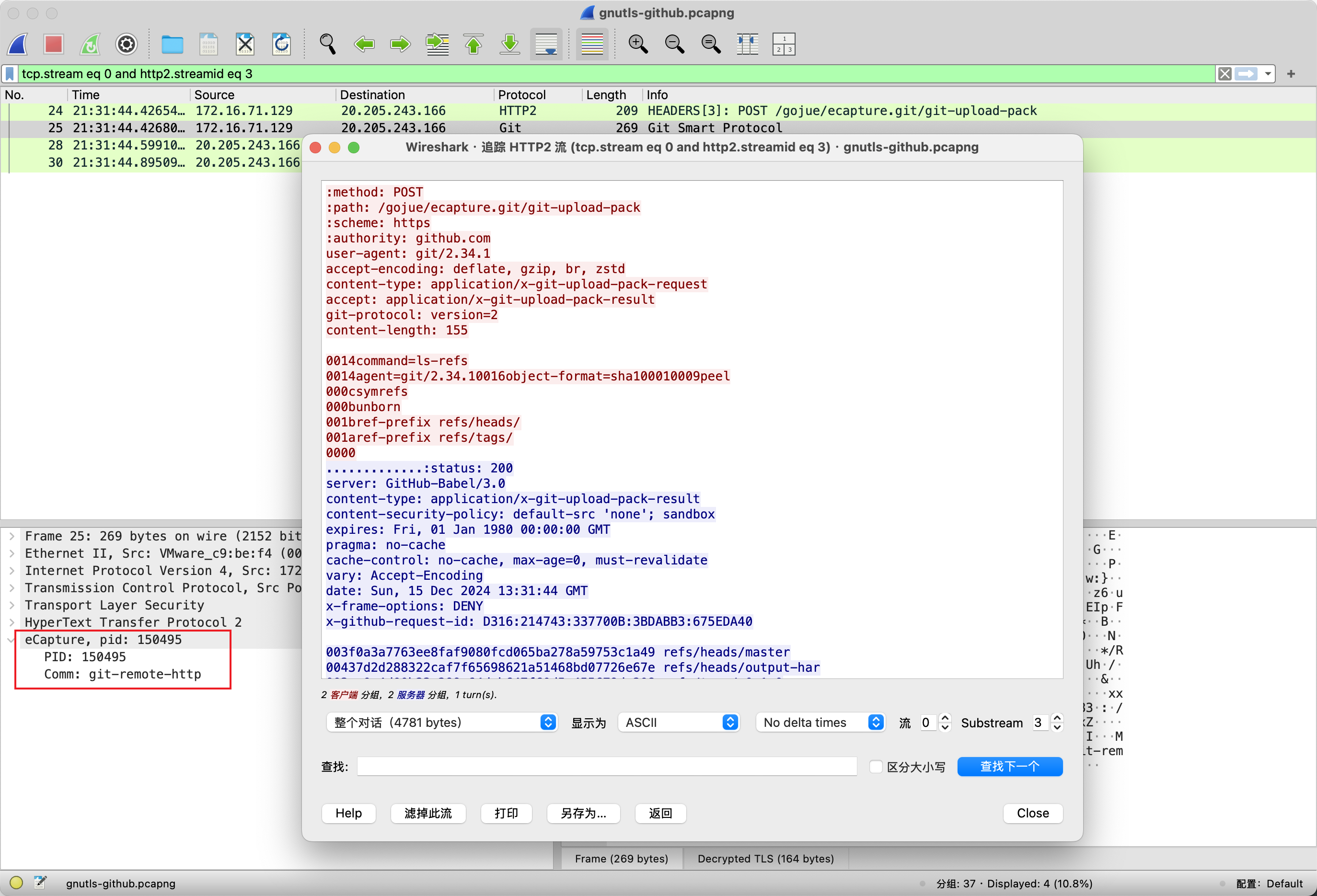
  1. Network packets captured by TC with process metadata (PID, comm)
  2. TLS master secrets extracted from SSL library hooks
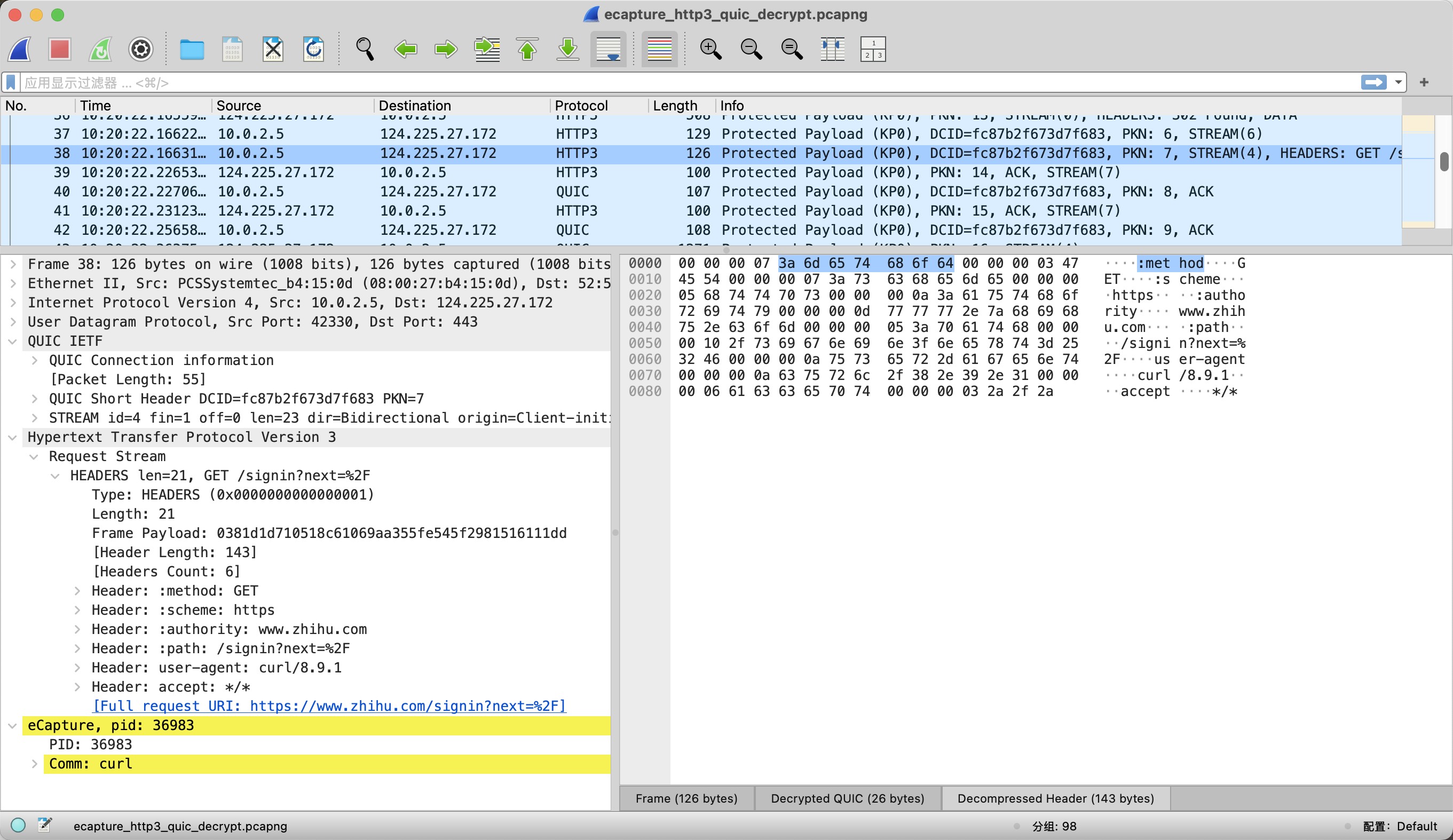
  3. PCAPNG DSB blocks embedding secrets for automatic decryption in Wireshark

For details on DSB generation, see PCAP Integration.

Sources: user/module/probe_openssl.go:558-565


Usage Example

Basic PCAP Capture

Capture all TLS traffic to a pcapng file:

bash
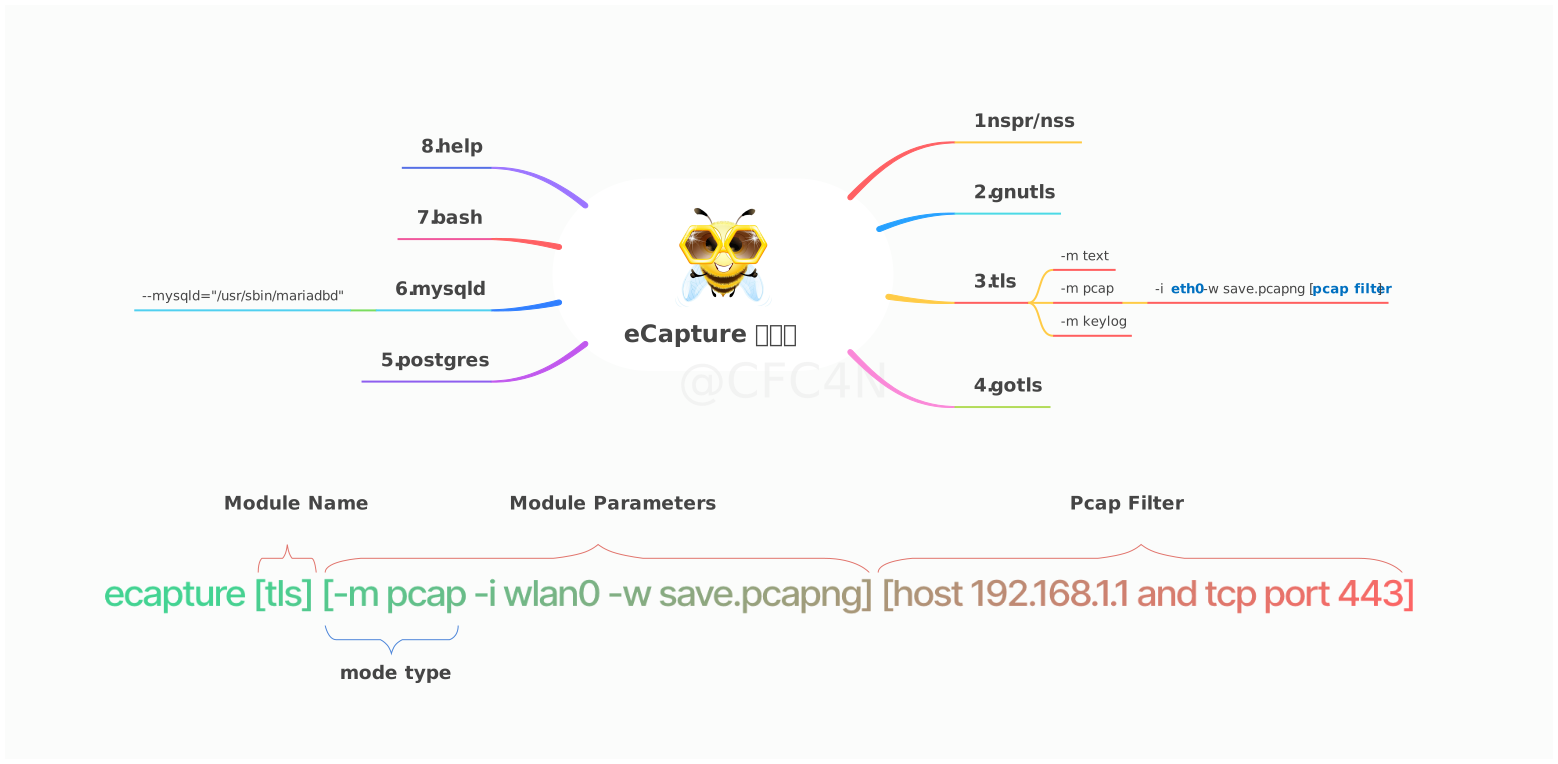
ecapture tls --pcapng=/tmp/traffic.pcapng

Filtered Capture

Capture only HTTPS traffic (port 443) for a specific process:

bash
ecapture tls --pcapng=/tmp/https.pcapng --pcapfilter="tcp port 443" --pid=12345

IPv6 Capture

Capture IPv6 TLS traffic:

bash
ecapture tls --pcapng=/tmp/ipv6.pcapng --pcapfilter="ip6"

Analysis with Wireshark

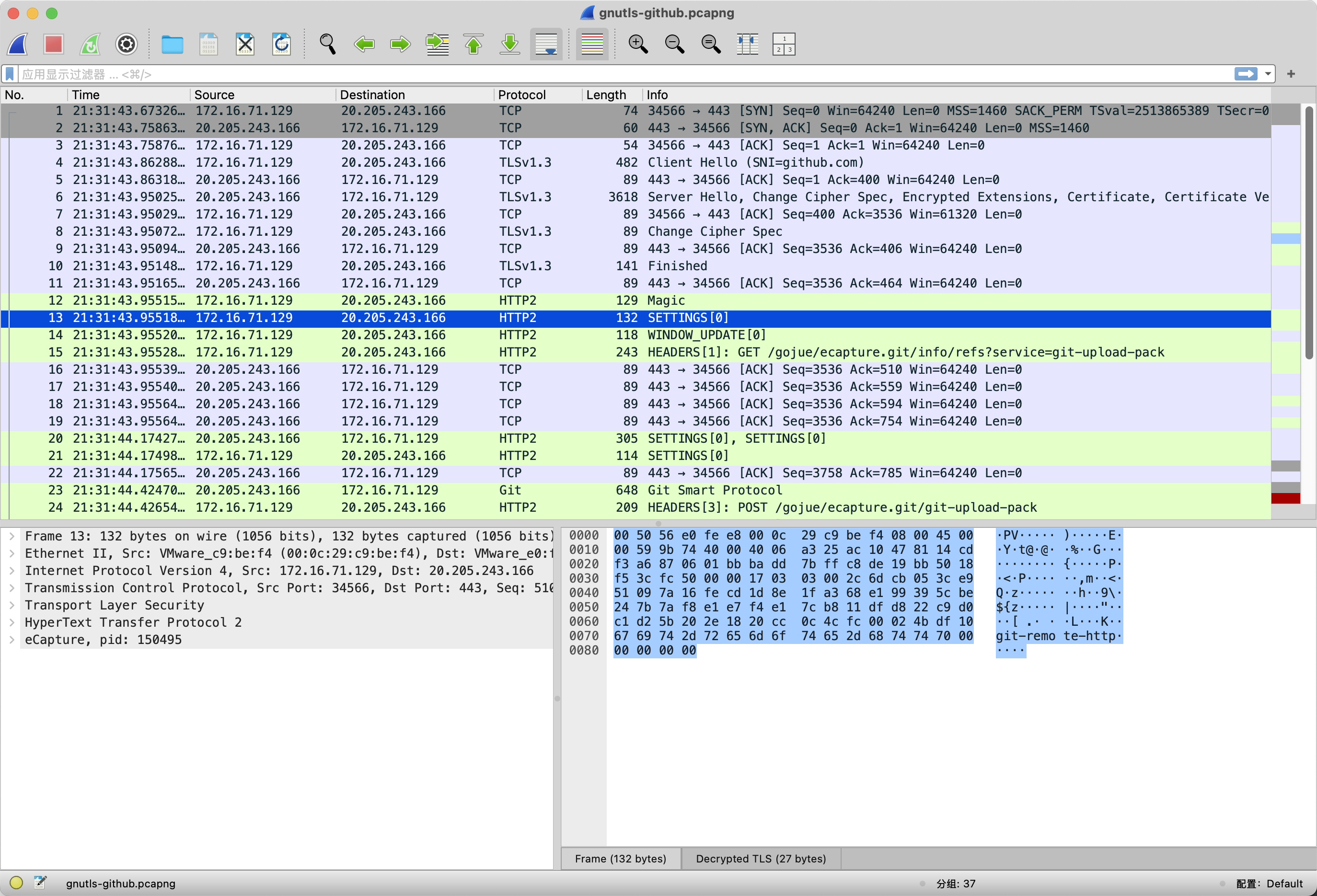
The generated PCAPNG file can be opened directly in Wireshark, which will automatically use the embedded DSB secrets to decrypt TLS traffic:

bash
wireshark /tmp/traffic.pcapng

For more information on output formats, see PCAP Integration and TLS Key Logging.

Network Packet Capture with TC has loaded